This is the S304 hand drawing, kept as a dated record (★H5). It has been SUPERSEDED by a graph generated from the corpus, which lives at /premise-graph/. Two of this drawing's named examples do not survive contact with the data — see /premises/ and the generated page. Nothing here is current; everything here is how it stood.
House diagram, S304 (2026-09-05), Rev32.7 basis. What every claim in the suite rests on, where measured data crosses back into a derivation,
where a postulate is injected, and which review state each node has reached. The node set is a skeleton chosen to show the mechanism, not the full claim register;
the per-claim graph is generated from the library's records when the rebuilt library ships. Tier words and quoted phrases are the suite's own. Nothing here promotes a tier.
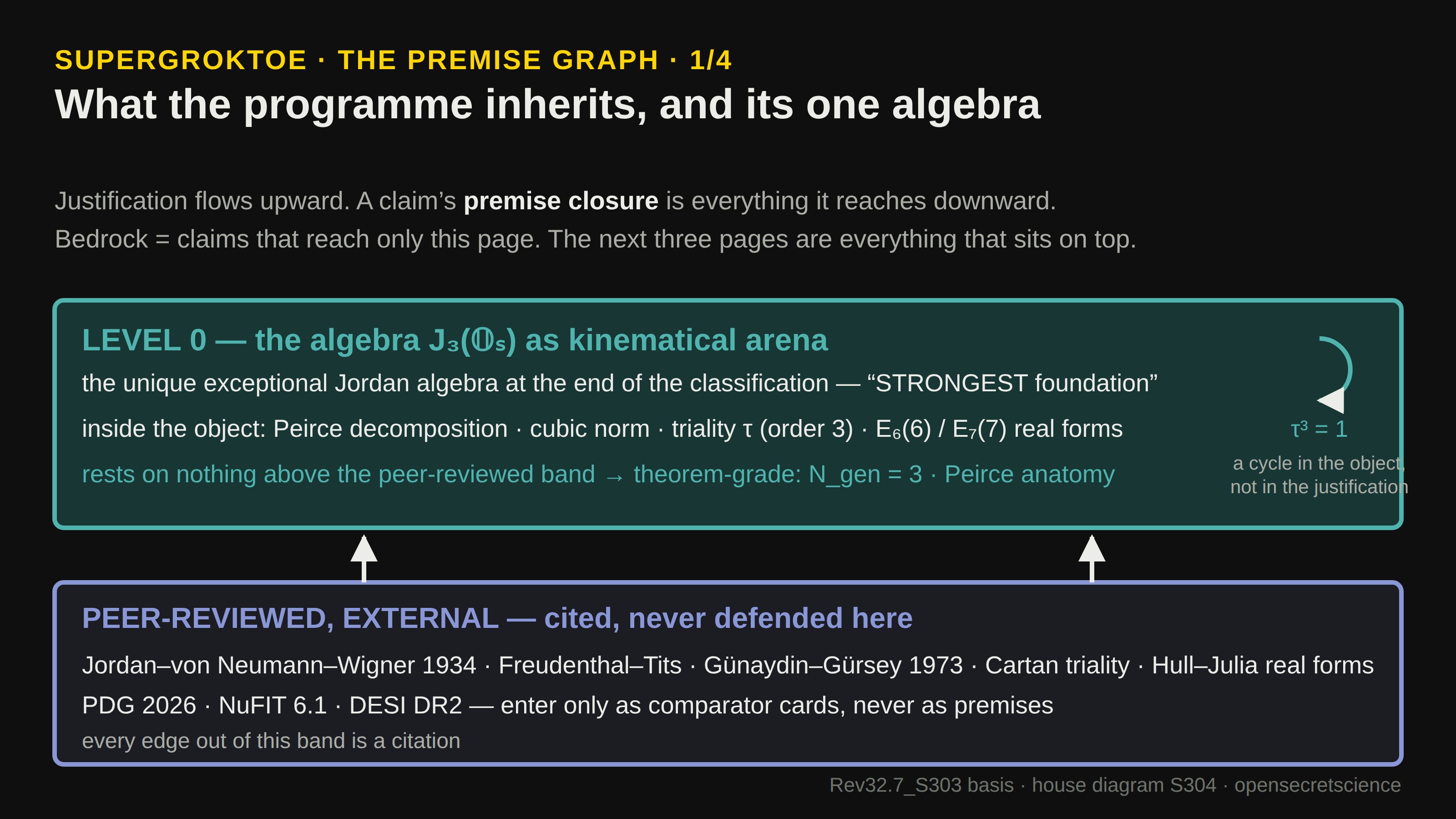
Justification flows upward. A claim's premise closure is everything it reaches downward; its height in the pyramid is computed from that closure, never assigned.
Two kinds of loop appear in the programme and they are different things: a cycle in the justification (a conclusion feeding its own premise) is forbidden and the
build rejects it; a cycle in the object — the order-3 triality automorphism τ, the finite carrier's cylinder condition — is a theorem about a declared object and is drawn
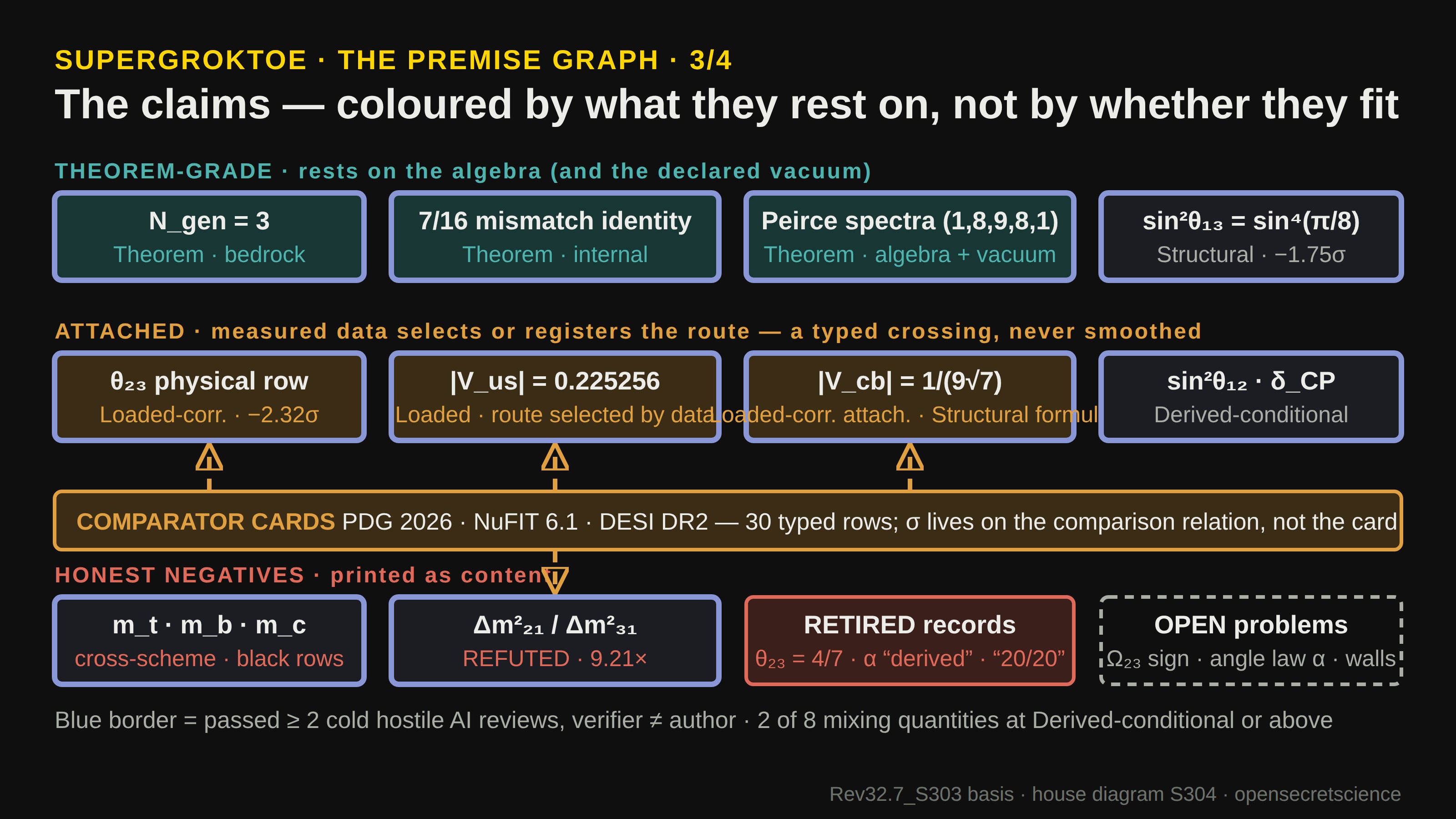
as a loop inside its node. Where measured data selects a route (the θ₂₃ octant, the |V_us| route) the edge is drawn as a typed crossing, never smoothed into a derivation.
Teal — theorem-grade internal result: rests on Level 0 (and the declared vacuum) only.
Ochre dashed edge — a crossing: measured data selects or attaches a route (Loaded / Loaded-correspondence). Typed, never smoothed into a derivation.
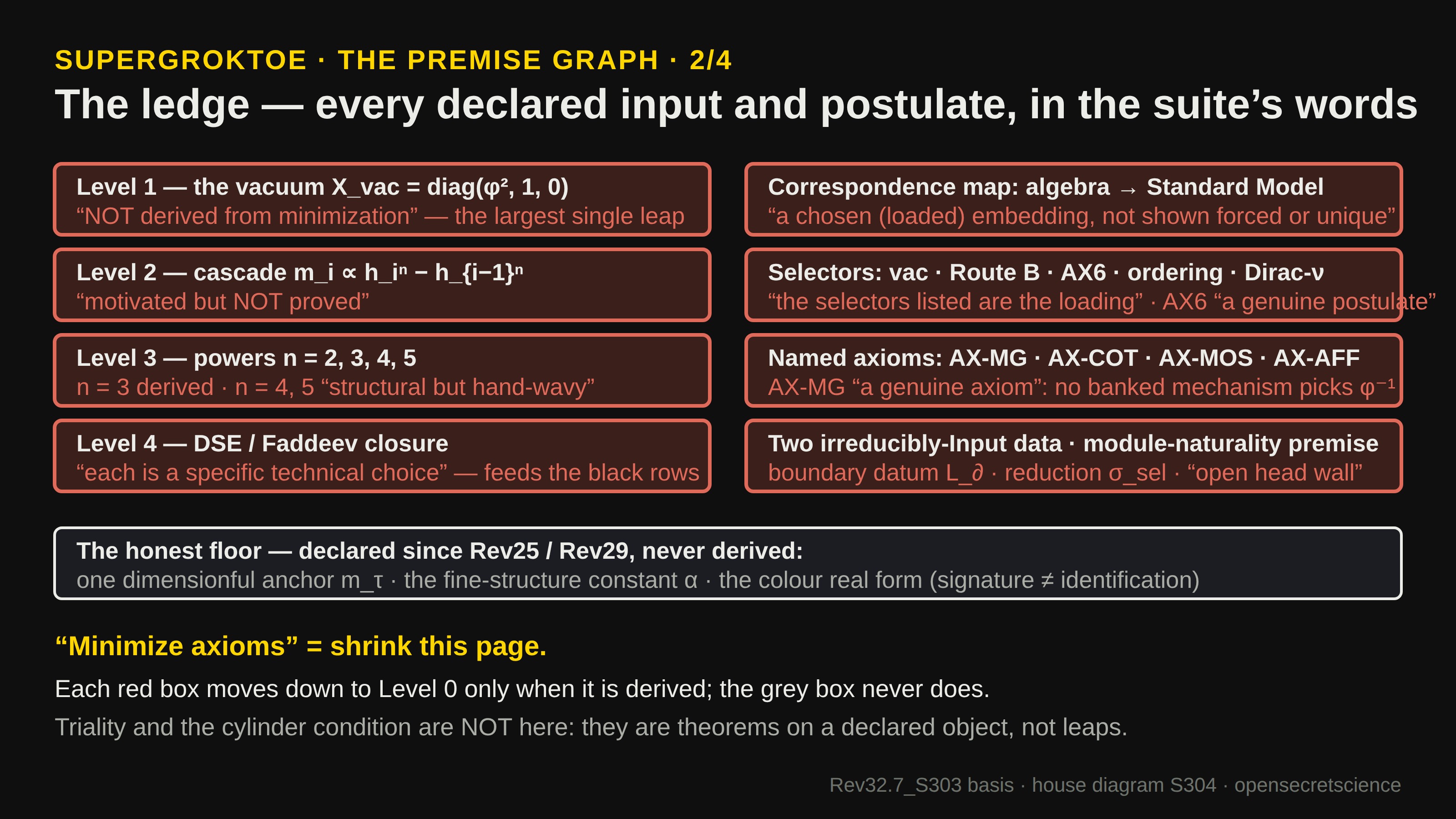
Madder — a postulate or declared input injected into the graph (the leaps).
Indigo double stroke — coalition-approved: hostile-reviewed by ≥2 lanes that did not author it. Single stroke = adjudicated by the house. Dotted = drafted or open.
Figure 1 — The dependency graph
Figure 1. Justification flows upward. Every claim's premise closure is the set of madder nodes it reaches downward; N_gen = 3 reaches none (bedrock); the θ₂₃ physical row reaches the vacuum, the correspondence map, and a data crossing. Object-level cycles — triality τ³ = 1, the finite carrier's cylinder condition — are drawn as loops inside nodes: they are theorems about a declared object and never appear as edges, so the graph stays acyclic. Indigo double strokes mark nodes that have passed at least two cold hostile reads; the top band is empty because nothing has yet been externally peer-reviewed.
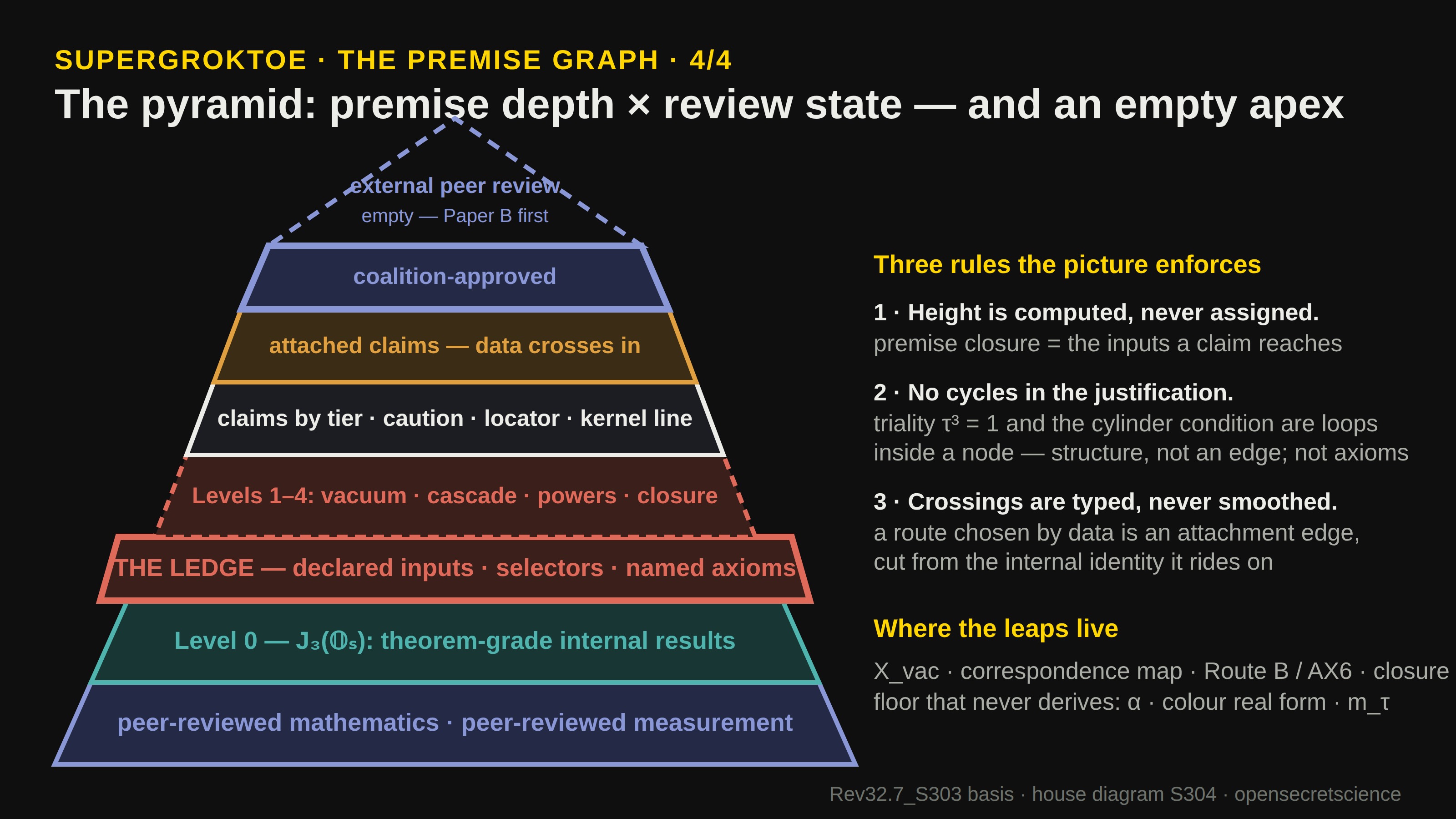
Figure 2 — The pyramid: premise depth × review state
Figure 2. The same graph filtered into strata. Width is a visual proxy for how much of the library rests on the stratum, not a count. The madder ledge protrudes on purpose: every declared input and postulate sits in one visible band between the algebra and the prescriptions, so "minimize axioms" means shrinking that ledge — and the reader can see exactly which nodes would have to move down into Level 0 (derived) for it to shrink. The apex is empty and stays drawn until Paper B returns from review.
The same picture in four panels
Correction, S312 (2026-09-06). Four phrases in this list are quoted from a house file, not from the suite: “NOT derived from minimization”, “motivated but NOT proved”, “structural but hand-wavy” and “each is a specific technical choice” are verbatim from Coalition/library/L-AssumptionStack_five_level_hierarchy.md, whose own header reads “Source: Claude.AI framework synthesis (A334, Session 24) · Type: Organizational framework”. They return zero hits in the sealed Rev32.7_S303 text and zero in the tex sources, checked hyphen-tolerant. The heading previously said only “in the suite’s words”. House-found while building the premise register; the drawing is left otherwise as dated (★H5), and the register at /premises/ records each premise’s source class explicitly.
Large-type versions for reading on a phone or sharing. Click any panel for the full-size image.
Three rules the picture enforces
Height is computed, never assigned. A claim's premise closure is the set of declared inputs and postulates it reaches through its dependency edges; its grade is the deepest level in that set. Bedrock is a claim whose closure is empty above the peer-reviewed band — N_gen = 3 is one.
No cycles in the justification. Triality (τ³ = 1) and the cylinder condition are cycles in the object — inherited theorems and counts on a declared carrier — not edges from a conclusion back to its premise. They are drawn inside their nodes and are not listed as axioms; the only input they consume is the declaration of the carrier, which is already ledgered.
Crossings are typed, never smoothed. Where data selects a route, the edge is an attachment (Loaded / Loaded-correspondence), cut from the internal identity it rides on — the atmospheric row is the reference case: a theorem-grade 7/16 identity and a data-registered octant are two records sharing one number.
Reading the ledge as a work list
"Minimize axioms" means shrinking the madder band. For each leap, what would move it down into the algebra — and which three never move.
node
status in suite
what would move it down
X_vac
Level 1 postulate; AX1 φ
a variational or cubic–quadratic selection that lands on diag(φ²,1,0) — AX-MG's non-selection theorem says no banked mechanism does yet
correspondence map
loaded embedding (p0)
uniqueness or forcing of the embedding; the observation-functor faithfulness wall (App X) is the named obstruction
Route B · AX6 · ordering · Dirac-ν
selectors = the loading
each replaced by a derived selection law; AX6 shown consequence of the CW chain (A621 says it is not)
cascade · powers n=4,5
motivated / hand-wavy
a proof from nested Peirce structure; associator counting made rigorous
DSE / Faddeev closure
technical choices
a parent equation fixing K_B, A, the GMOR proxy — or the black rows retyped honestly as Level-4 outputs
module-naturality premise
open head wall
derivation from the microscopic parent action (App X priced-clause register, row 1)
α · colour real form · m_τ
declared inputs
nothing — these are the honest floor; the ledge never reaches zero
Sources for every node and quotation: the Rev32.7_S303 suite (Paper 0 zero-fit paragraph; Appendix X input ledger and priced-clause register; Appendix S non-selection theorem; Appendix P finite carrier), the programme's five-level assumption stack, and the scorecard. Suite PDF and machinery are served at /papers. House diagram S304; not peer-reviewed; the apex of the pyramid is drawn empty for that reason.